











Editor’s Note: I discovered Safety, Harbor, Florida-based Sawyer Products while investigating a story on insect repellents. Sawyer not only has effective repellents but is also in the water filtration business. They make systems for camping and a number of other applications. In perusing their website I noted “Mission Fiji“, the company’s NGO project to bring clean, drinkable water to the Fiji Islands.
I was not expecting to see “Fiji” come up on this company’s website. Suffice to say, I was pleasantly surprised. I was also pleased to see that in a world where being a good Samaritan is looked upon by so called “thought leaders” as “woke”, here was a U.S. company going out of their way to bring clean water to rural communities in Fiji (and other Pacific Islands).
I know how crucial access to drinkable water is in Fiji because I contracted a parasite in a Viti Levu village many years ago and became very ill. Being a privileged white guy, when I returned home, I was lucky enough to have a tropical medicine doc assess the situation and get me the meds I needed.
Not everybody in Fiji has that luxury.
Because of that experience, I am acutely aware of what it’s like to be in an environment where one must rely on unsafe wells or rivers for their water supply.
I applaud Sawyer’s efforts to access safe, drinkable water in Fiji and elsewhere.

The road to border-to-border clean water
In a groundbreaking public health initiative entitled “Give Clean Water”, Fiji is on track to become one of the first nations in the world to implement a border-to-border clean water solution.
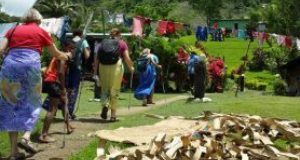
Sawyer Products is delivering safe drinking water to nearly half of Fiji’s population, mostly in remote and rural communities, long dependent on untreated and often contaminated water sources.
For many Fijian families, clean water has never been a guarantee.
Rural communities often rely on wells, rivers, or rain catchment systems that are easily compromised by animal waste, parasites, agricultural runoff, or aging infrastructure. As a result, waterborne illnesses such as diarrhea (or in my case parasites) can take a toll on public health and daily productivity—affecting everything from school attendance to family income. But thanks to an innovative partnership between Give Clean Water, Sawyer Products, and the Fiji Ministry of Health, that is rapidly changing.
A Simple Filter, Profound Impact

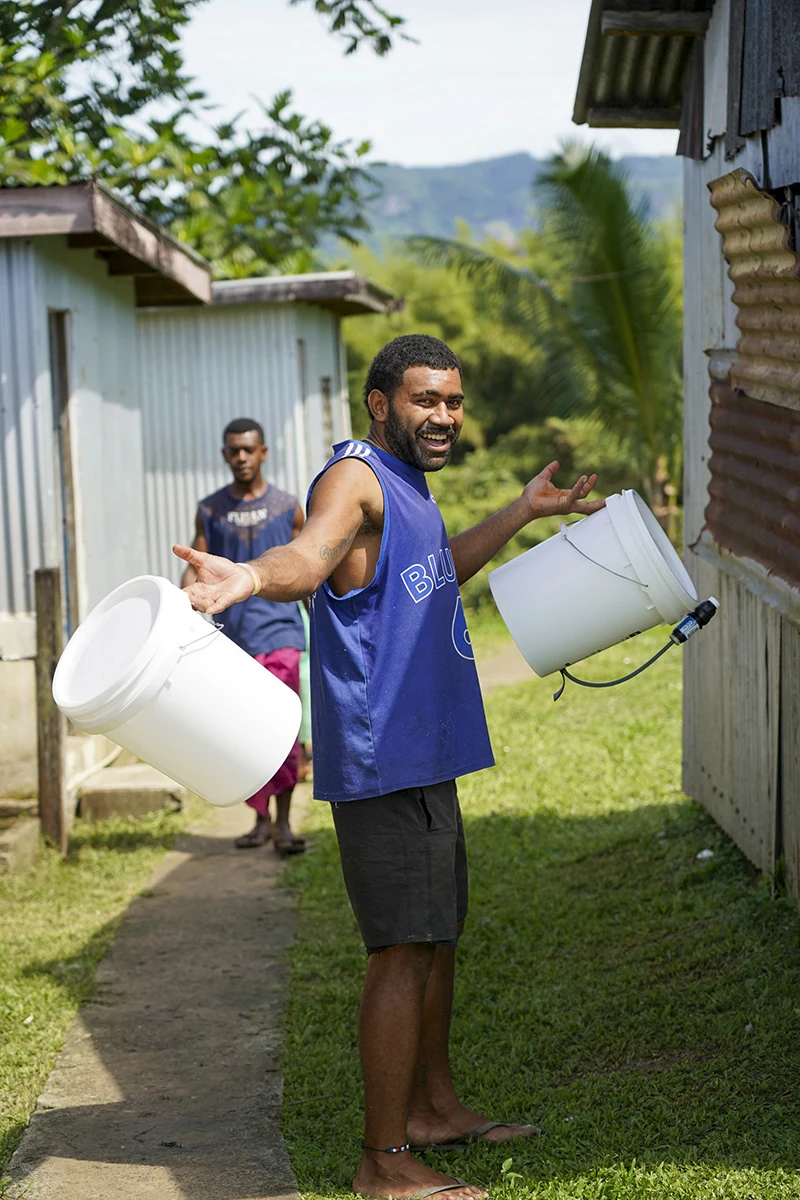
At the heart of this transformation is a remarkably simple and effective technology. The Sawyer filter uses hollow fiber membrane technology to remove 99.99999% of bacteria and 99.9999% of protozoa from freshwater sources. It requires no electricity, chemicals, or complex maintenance. The filter simply attaches to a 20-liter bucket—an item found in almost every Fijian household—and delivers clean, safe water suitable for drinking, cooking, and cleaning.
This design makes the filter ideal for hard-to-reach areas, where infrastructure development is challenging or cost-prohibitive. Each unit is capable of filtering up to 300 gallons per day, more than enough for the daily needs of a family.
Tracking Success with Technology
The effort isn’t just massive in scope—it’s also meticulously monitored. Using GIS (Geographic Information System) technology, project teams are tracking the location and use of each filter and gathering robust data on health and economic outcomes.
Every family that receives a filter voluntarily participates in a baseline survey and follow-up assessments at two and eight weeks. These surveys, developed with the support of a U.S.-based university, measure changes in:
- Incidence of diarrhea
- Days of school and work missed due to illness
- Money saved on bottled or boiled water
- Medical expenses avoided thanks to fewer waterborne diseases
Preliminary results are already promising. Participating households have reported an average monthly savings of $22.46 USD in medical costs, $10.50 in reduced spending on water, and a 1.13-day increase in adult work productivity per month. For many families living close to the poverty line, these gains are not just meaningful—they’re transformative.
Ensuring Long-Term Sustainability
Providing clean water is one thing; ensuring families continue to use and maintain the filters properly is another. That’s why the project places a strong emphasis on follow-up and behavior change.
At both the two- and eight-week marks, trained intervention teams return to each village. They observe and support families as they demonstrate proper filter use and cleaning. These visits are not just check-ins; they’re educational touchpoints that reinforce good hygiene practices and build community confidence in the technology.
Data from these follow-ups are also collected, allowing researchers to measure not just the health impact, but also the long-term sustainability of the intervention. These findings are published twice a year in peer-reviewed journals and presented at clean water conferences around the world, positioning Fiji as a global model for community-led, data-driven water security.

A Decade in the Making
The current national rollout builds on more than 15 years of work by Give Clean Water, which has partnered with the Fiji Ministry of Health since 2008 to develop best practices for the implementation and sustainability of household-level filtration solutions. What began as small pilot projects in a handful of villages has now scaled to a national strategy—one that uses data and community engagement to tackle a basic human need with extraordinary efficiency.
Looking Ahead
The Fiji clean water project is an ongoing endeavor. Beyond the filters, the initiative is leaving behind something even more valuable: a framework for how nations can address rural water insecurity without waiting for large-scale infrastructure projects or costly municipal systems.
By combining low-tech innovation with high-tech monitoring and deep local partnerships, Fiji is proving that safe, sustainable, and equitable access to water isn’t just a global aspiration—it’s an achievable goal. One family, one bucket, and one koro at a time.

One last note: If you’re headed to Fiji consider bringing a bottle of Sawyer’s 20% Picaridin Insect Repellent. I used it Hawaii and it works wonderfully. And yes, if you’re in a rural part of Fiji and are unsure about the source of water, bring bottled water to drink.
If you live in Fiji and are interested in connecting with a Sawyer representative to help your community, contact Darrel Larson (darrel@sawyer.com)–founder and Director of Give Clean Water and International Director of Sawyer Products. Currently most of Sawyer’s village projects are on Viti Levu but Mr. Larson is open to helping communities throughout Fiji.