



Exploring Suva Attractions on foot
Suva, with its multi ethnic population and modern vibe, is the leading metropolitan city of Oceania. In the capital city you will find all the activities you could possibly want–culture, art, recreation, shopping, museums, galleries, markets and nightlife. Suva continues to evolve with new office complexes such as Tapoos and the BSP Suva Central building, complete with food courts and a supermarket.
Nearby you will also find the Village 6 Cinemas, the art deco Regal Cinema (now a restaurant), the Suva Handicraft Centre, international restaurants and pubs, Suva Museum, Suva Olympic Swimming Pool, Suva Flea market and other landmarks.
The good news is that you can see most everything on foot by yourself or with the assistance of Peter Sipeli who’s Guided Walks offers an excellent private tour.
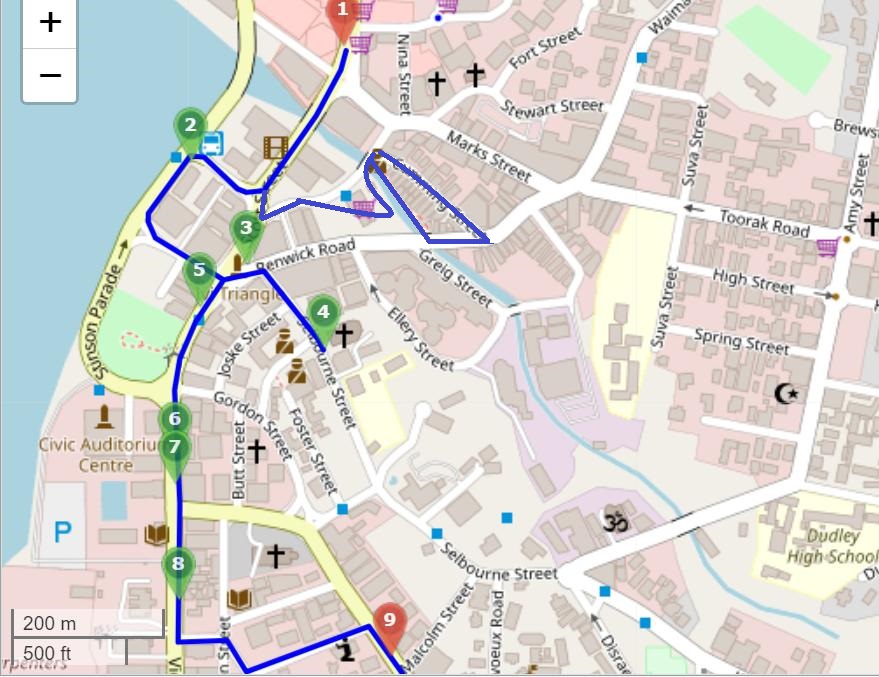
Walking Tour
Suva attractions are manifold but keep in mind, you’ll want to see them on foot. Most of it can be seen in one day. You need not be an Olympic athlete to take a walking tour, but the heat – especially for those not used to it – can make a stroll around Suva seem arduous.
(1) Suva Municipal Market
When you come to Suva — either by sea, via the Queen’s Road along the coast or on Edinburgh Drive on your way in from the airport at Nausori — the Suva Municipal Market is one of the first reminders that this is, indeed, a cosmopolitan town. On the market’s ground floor, you’ll see Polynesian, Chinese, Indian and Fijian vendors hawking everything a local household might need.
Choose your food: Fish? Freshwater prawns? Goat meat? Crab? Passion fruit? Taro? Cassava? Eggplant (also called “baigan” in Hindi or “baigani” in Fijian, depending on the language of the seller)?
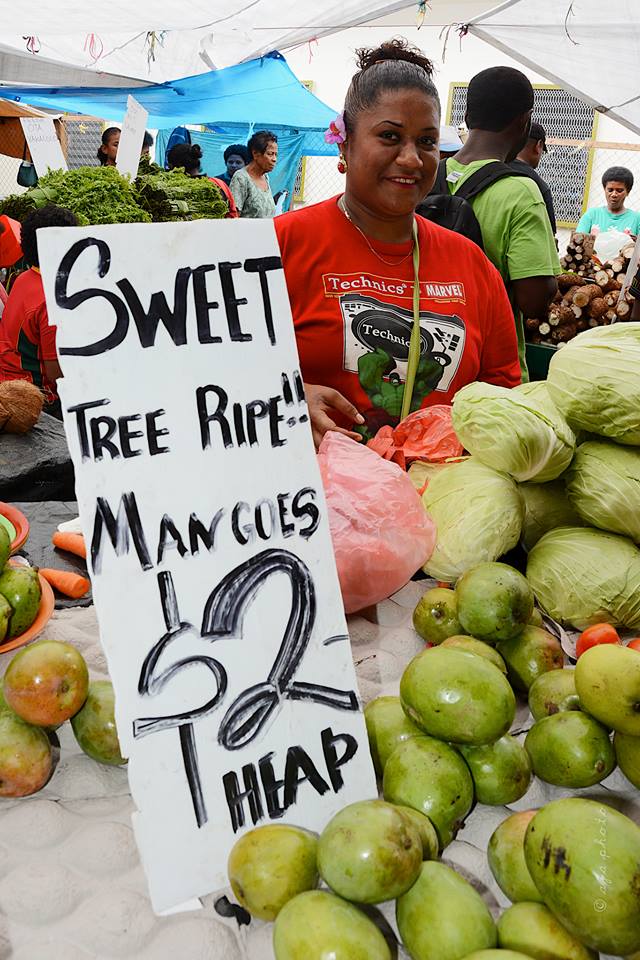
Other merchants sell Indian spices, freshly gathered shellfish, tomatoes or offer bundles of dalo (taro root). A section of new kiosks toward the bus station is the place to purchase `Indian sweets’, many of which are not sweet at all, but rather are highly spiced and tasty snacks.
If you’re in the mood there’s also a `yaqona saloon’ outdoors at the wharf end of the market dedicated solely to yaqona tipplers. As you walk by, someone may call over, urging you to have a bowl. Should you take them up on it, for a dollar buy a round for the house, which is the customary reciprocal thing to do.
(2) Suva Curio & Handicraft Centre and Suva Flea Market
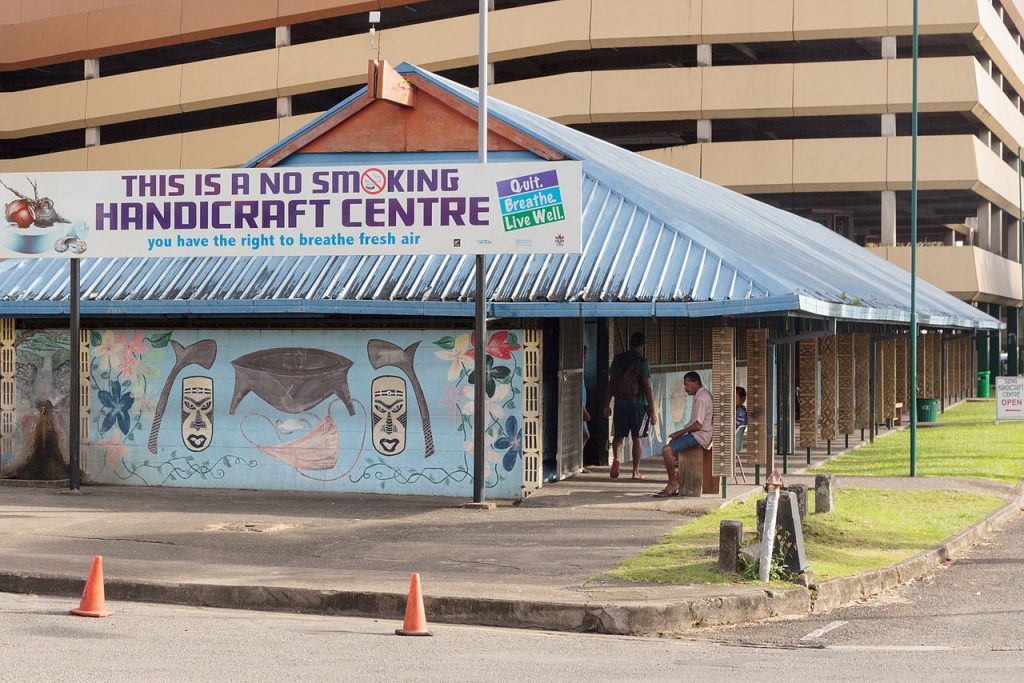
Visitors interested in a more complete selection of handicrafts should note there are two other marketplaces worth perusing.
The first, operated under the aegis of the Suva City Council, is the Suva Curio & Handicraft Centre, located about 300 feet from the Suva Municipal Market, toward the center of town, just off Stinson Parade, next to the modern multistory Car Park.
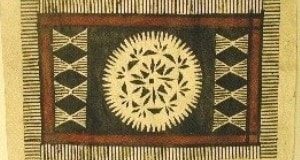
It’s a long, cinderblock building populated by carvers and other craftspeople. There is a plethora of stalls stuffed with carvings, shell necklaces, mats, handbags and other items. Here you can learn to distinguish between the dark, finely patterned Fiji “masi” — tapa, or bark cloth — and the light brown Tongan “ngatu,” with its freer design. Or choose between the round or turtle-shaped “tānoa,” the bowls used for preparing and serving kava.
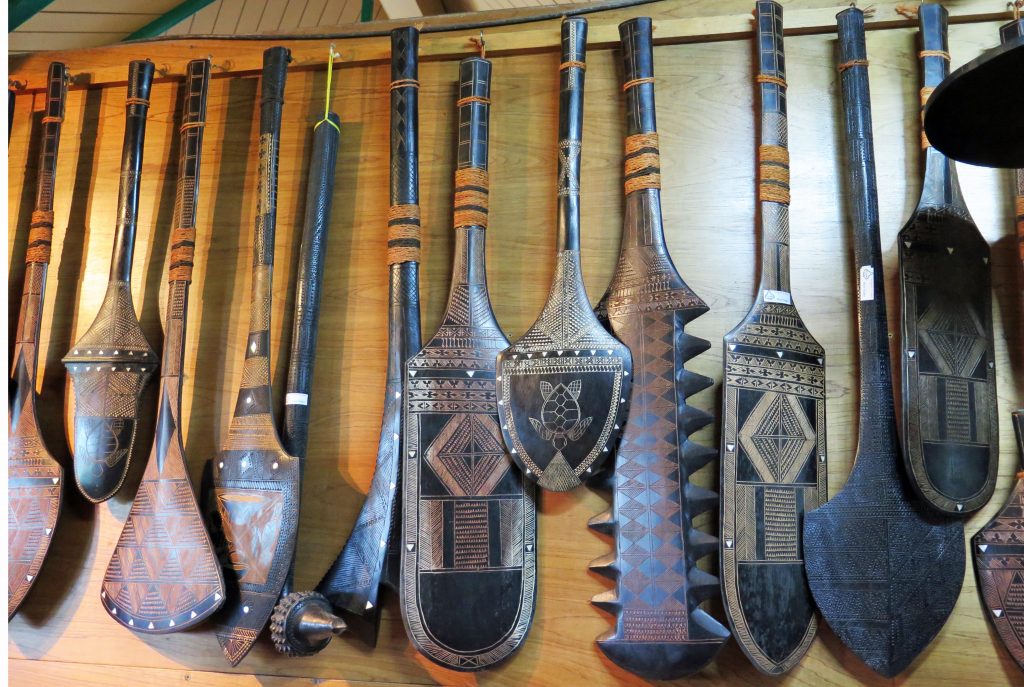
The second market, the (upgraded) Suva Flea Market, on Rodwell Road, directly across the street from the bus stand. It has 160 shops in a streamlined, modern setting, more akin to a mall rather than the bazaar that characterized the earlier incarnation. In addition to wooden and woven handicrafts such as baskets, like those found at the Curio and Handicraft Center, it offers shoes, cosmetics, clothing and textiles targeted at local people. There are also individual shops catering to musicians and artists.
Don’t dismiss the items for local consumption. If you spend a little time, you may find fabric that will make an excellent tablecloth or table mat. If you need your shoes repaired, or a tailor to hem the fabric you purchased for a tablecloth, this an excellent place to find someone who can do such things. There are also inexpensive but decent eateries inside the Suva Flea Market.
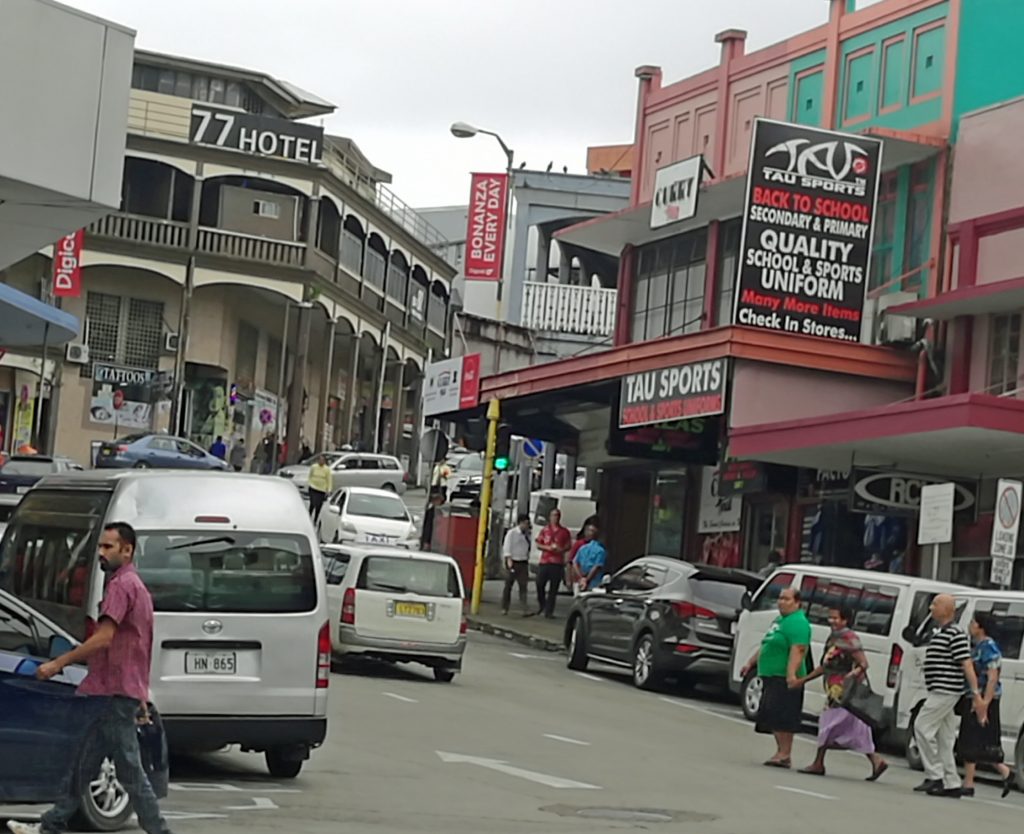
Cumming St.
One of the most picturesque parts of the city, Cumming Street, did not appear at all on early maps. The area formerly was a low-lying swamp extending most of the way from Marks Street to Ellery Street, the site of a former refuse dump. The district was reclaimed in the early 1900s, and gradually the street developed into a commercial area.
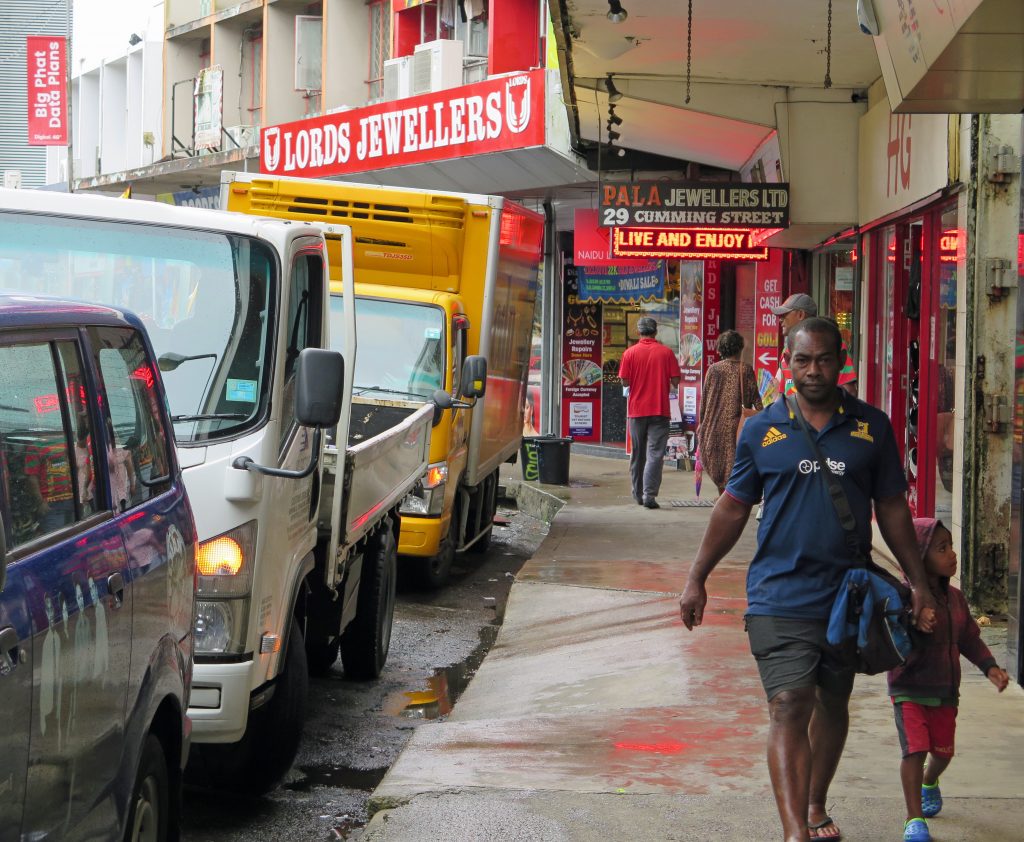
After a 1923 fire destroyed most of the buildings on the street it was the home of the Suva Market for more than 20 years, until the market was moved to its location on Edinburgh Drive next to the bus station.
Also prominent in the area were its yaqona (kava) saloons — “dens of iniquity” of the 1920s — and the curry shops, known as lodges.
On the rest of the street, shopkeepers such as tailors, barbers and café owners changed gradually during World War II into sellers of curios and artifacts, when military personnel provided potential shoppers. The businesses changed again in the 1960s when the nation removed its import duties from a large selection of electronic goods.
Nowadays, Cumming Street is still a cheek-to-jowl collection of retail outlets, ranging from beauty salons to clothing and fabric shops. However, it’s no longer a center of duty-free shopping, as it was decades ago. Tax laws had changed, except at the airport, and Fiji no longer provides any duty-free benefits.
(3) The Triangle
The true historical center of Suva is the Triangle, but those visitors who have seen it now would not have recognized it a century ago. Then it was a small lagoon fed by a creek coming down Pratt Street.
As was most of the land on the seaside of Victoria Parade, it was filled in, and it now serves as a small park, with a bench under the ivi tree at the apex, and (especially on ship days) a row of handicraft vendors at the base. Unfortunately the venerable tree sustained enormous damage during Tropical Cyclone Ana in January of 2021 but survived in diminished form. It’s hoped that someday it will return to its former glory.
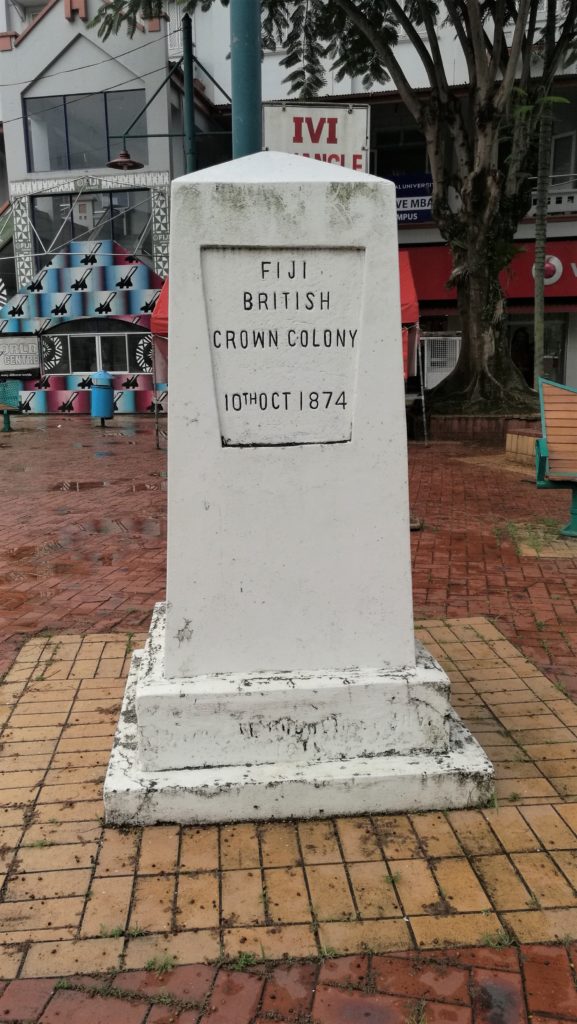
Inside the triangle is what is usually called a “historic marker,” and it is an unusual one, for three of the four inscriptions are wrong, even if only slightly so:
>> “Suva Proclaimed Capital in 1882.”
Well, not really. The Home Government approved the move in March 1877, the Queen gave her approval in May, and on Aug. 1, The London Times was the medium for the public proclamation. 1882 was the date of the government’s official move from Levuka.
>> “Cross and Cargill First Missionaries arrived 14th October 1835.”
Well, close. The correct date, confirmed by Cross’s and Cargill’s diaries, was Oct. 12, 1835.
>> “Public Land Sales on this spot 1880.”
Someone found the wrong ivi tree. The land sales were held farther down Thomson Street, near the site of Morris Hedstrom and Company’s (originally Morris, Hedstrom, Ltd.) store.
The city fathers got this one right. (Rob Kay, 2019)
>> “British Crown Colony 10th October 1874.”
This one is right.
Development has changed the appearance of much of Victoria Parade. But if you continue walking south, you can still find some buildings such as the Old Town Hall and the Suva Carnegie Library that reflect the earlier character of the street.
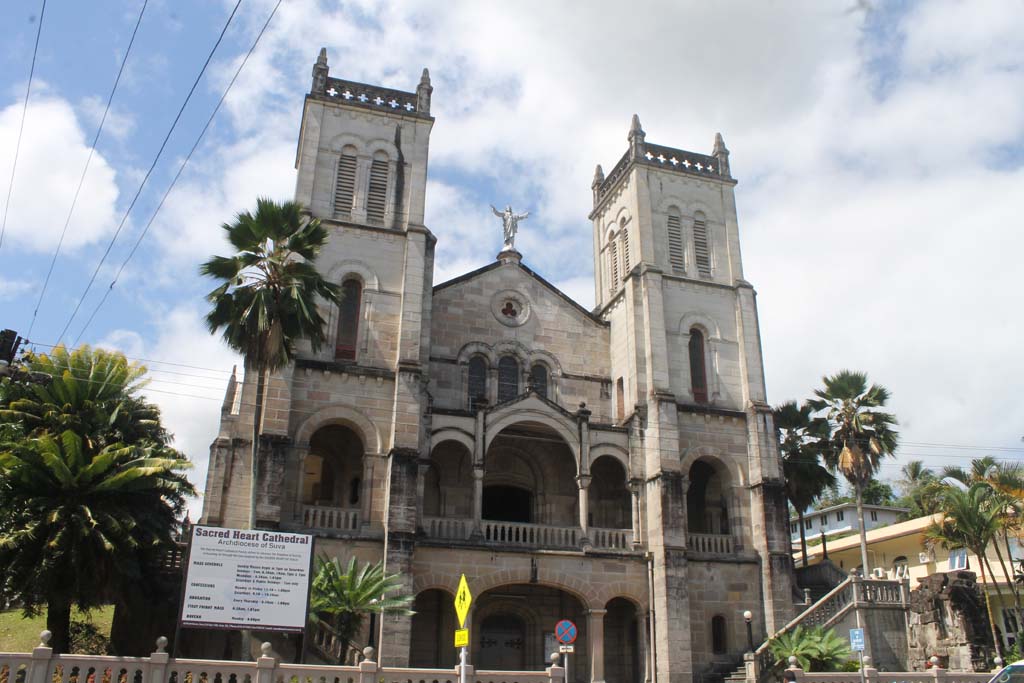
(4) Sacred Heart Cathedral
The Sacred Heart Cathedral also known as the Cathedral of Suva, is Fiji’s most prominent Roman Catholic edifice. Located on Pratt Street, construction of the building began in 1894 but it wasn’t completed until 1939, nearly 100 years after the first Marist missionaries arrived in Fiji. The grand neo-Gothic design includes sandstone blocks imported from Australia, concrete staircases and balustrades, and two towers. The central stained-glass window above the altar contains an image of a bilo (coconut shell cup) beneath the Sacred Heart of Jesus.
The cathedral serves as the headquarters of the Metropolitan Archdiocese of Suva (Archidioecesis suvana) which was created in 1966 by Pope Paul VI by bull “Prophetarum voices”. A crypt completed in 1896 now contains the remains of Archbishop Emeritus Petero Mataca, who was entombed in 2014. The cathedral is depicted on a Fiji stamp issued in 1979.
If you retrace your steps back to the Ivi Triangle and cross Scott Street, you’ll find Suva’s most distinctive art deco treasure.
(5) The Regal Theater
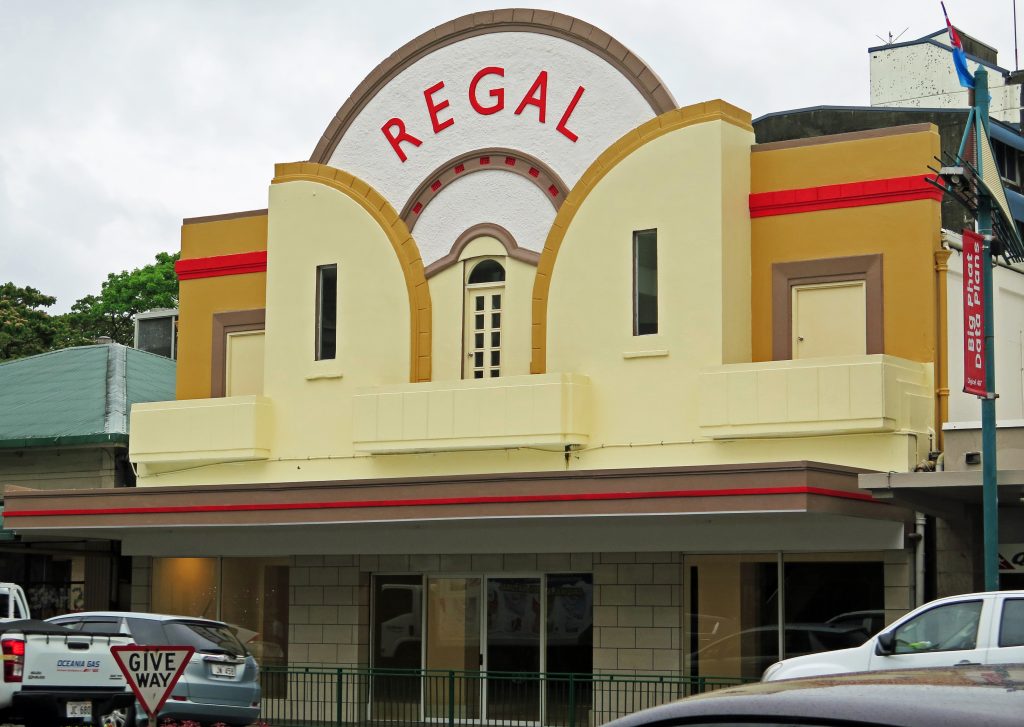
According to a February 22, 2021 Fiji Sun article, the Regal was the original flagship theater of Damodar Cinemas in Fiji—one of the preeminent cinemas in town. It was air conditioned, which was unusual for the era. In 1997 it closed its doors and was transformed into an arcade filled with coin operated games. The building was converted into a two-story retail outlet in August 2019. A second-hand women’s clothing store currently occupies the bottom floor, while a men’s shop, along with the book section, and the Catch Up Café is on the top.
Architectural note: The architecture of the Regal Theater is art-deco and modernist design, a style that was popular in Australia, Britain and the USA. Built around 1920, the building characteristically includes vertical, zigzagged elements and round-fanned geometric art deco designs. The front-facing symmetrical exterior has two bays, fronting walls and minimal designs flanking the main primary decorative and centralized bay. Balconies for each bay extend above the street level verandah. In general, the architect also may have been influenced by Cubism, Constructivism, Modernism and Futurism — movements in vogue during the 1920s.
(6) Suva City Carnegie Library
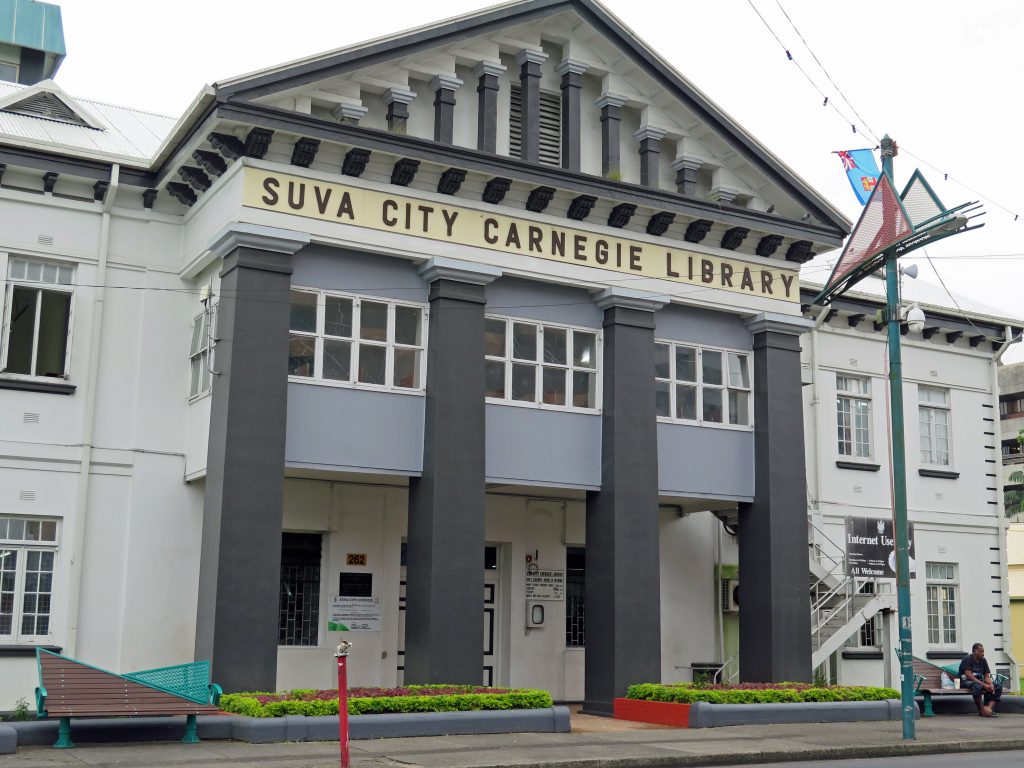
Along with many other countries, Fiji was the recipient of a grant from Andrew Carnegie for a public library. In 1908, the philanthropic steel magnate provided £1,500 to build the library, with the Suva Town Board providing a building site and £150 per year to maintain the building.
The library, built on one of the two waterfront sites that did not have to be reclaimed, opened in late 1909 with an initial collection of 4,200 books. The foundation stone of the original section, in the middle of the current structure, was laid by Gov. Everard im Thurn on Sept. 1, 1908, while G.J. [Gabriel] Marks was warden (mayor) of Suva.
In the 1930s and ‘40s, book clubs fostered a circulating library, which by 1944 grew to 3,000 volumes and 330 subscribers.
In 1953, the name of the library was changed to Suva City Library. The next year, the Fiji Museum, which had occupied the top floor of the library since 1930, moved to its new quarters in the Suva Botanical Gardens, later named Thurston Gardens.
The library’s collection was significantly increased in 1966, when the British Council in Suva turned over its 6,804 volumes.
As Cerelala and Pene make clear in their book, Suva City Carnegie Library 100th anniversary 1908-2008, marking the 100th anniversary of the library, the book depository witnessed many changes during its first century. Among them: a return of “Carnegie” in 2008 to the official name, internet service, a children’s library, a mobile library service, a significant renovation and a number of progressive programs that integrate the library with the needs of its patrons.
(Long-term visitors should also check into the University of the South Pacific Library on the USP campus, which has the best books in the country.)
(7) Victoria Parade
Victoria Parade is Suva’s showcase. Originally an unpaved street with only a row of raintrees between it and the shore, the city’s main drag has seen the sea recede as more and more land has been reclaimed.
Ambitious city plans once showed a visitors’ village nestled among man-made lagoons in the vicinity of the Civic Centre. In view of global warming, it’s probably best that the project never materialized.
Nowadays, Victoria Parade remains the throbbing epicenter of business, government and shopping. Every bank, bureaucratic complex and travel bureau is on the street, or within a stone’s throw. To sightsee in Suva means strolling down Victoria Parade.
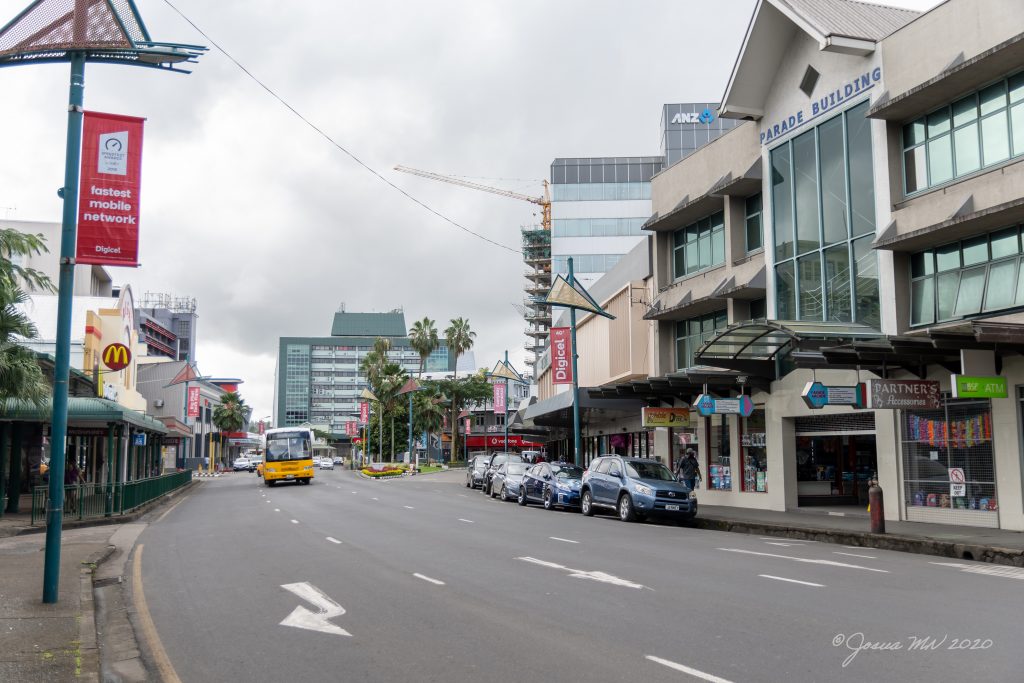
As a 1991 Los Angeles Times piece stated: “Stroll is the operative word. No one rushes in Suva. It is simply too hot and humid to go faster than a modified trot. Also, if you race, you will be stared at with vague disdain, the only disdain you’re likely to be shown in ultra-friendly Fiji.”
You’ll want to don a comfortable pair of shoes and take an umbrella. Chances are it will rain. Even if it doesn’t rain, the umbrella will make walking in the tropical sun a bit more bearable.
If you plan to visit during the rainy season, consider waterproof shoes. The torrents of water rushing down the streets during a downpour are astounding.
The main thing, as the above LA Times comment suggested, is to take your time.
Note that Victoria Parade officially starts at the convergence of Thomson and Renwick streets, which is fitting, since their namesakes were business partners, and that spot has its own name: The Triangle.
(8) Old Town Hall
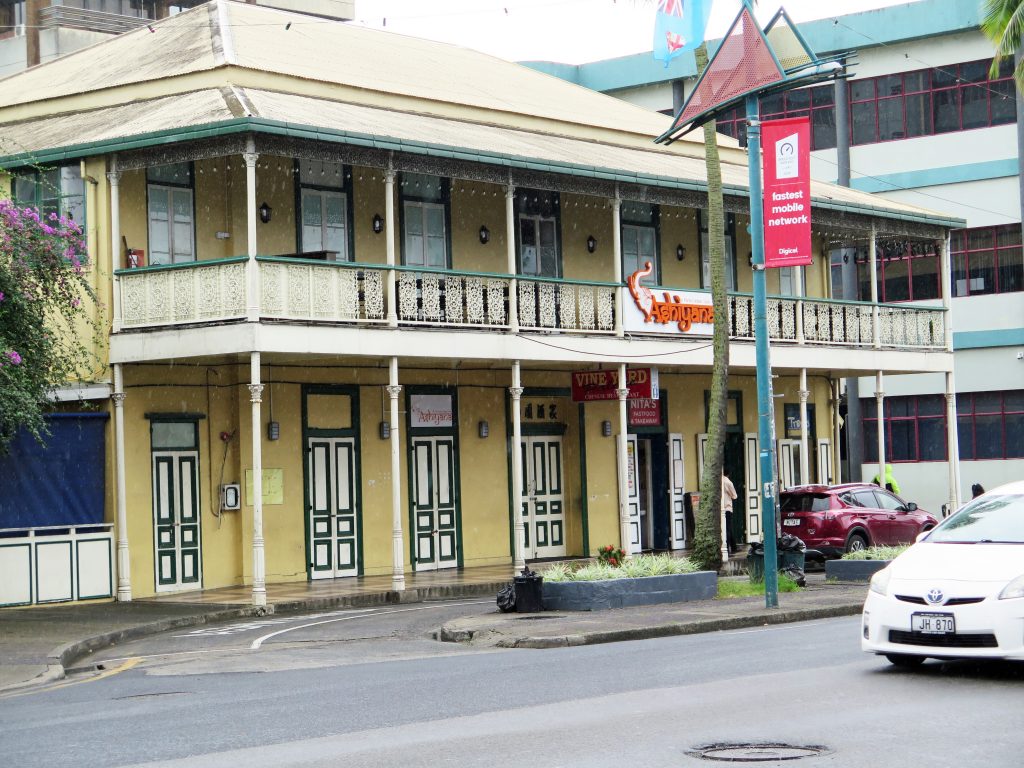
Built in the early years of the 20th century as Queen Victoria Memorial Hall, Suva Town Hall — located on Victoria Parade next door to the Suva City Library — was praised as one of the town’s amenities of civilization. A 1910 tourist guide proclaimed that “it is well lighted with gas, and has a good state drop scene and scenery.
Here visiting companies perform, and local amateur shows, dances, bazaars are held. The Municipal Offices and the Council Chamber are on the ground floor, and the upper story is used as a museum, where many valuable island curios and antiquities are on view.”
As an example of the entertainment it offered, The Fiji Times in 1914 praised the Pharos Co.:
The full company comes direct from America, the home of good vaudeville. The Steele Sisters are a duo of pretty girls of the Gibson type, whose dresses are said to surpass anything ever seen here. … Baby Alma, the shining little star returns from a triumphal tour of the States and will appear in new songs and dances. Bobby Blue the comedian, is of the refined order.
Especially because of its balconies and ornamental iron, the Town Hall is recognized as one of Suva’s finest examples of colonial architecture.
These days, the building is the home of the Vineyard Palace Restaurant, located on the ground floor, while upstairs is the Indian restaurant Ashiyana. If you are an Indian food aficionado, don’t miss this eatery.
Olympic Pool (behind Old Town Hall)
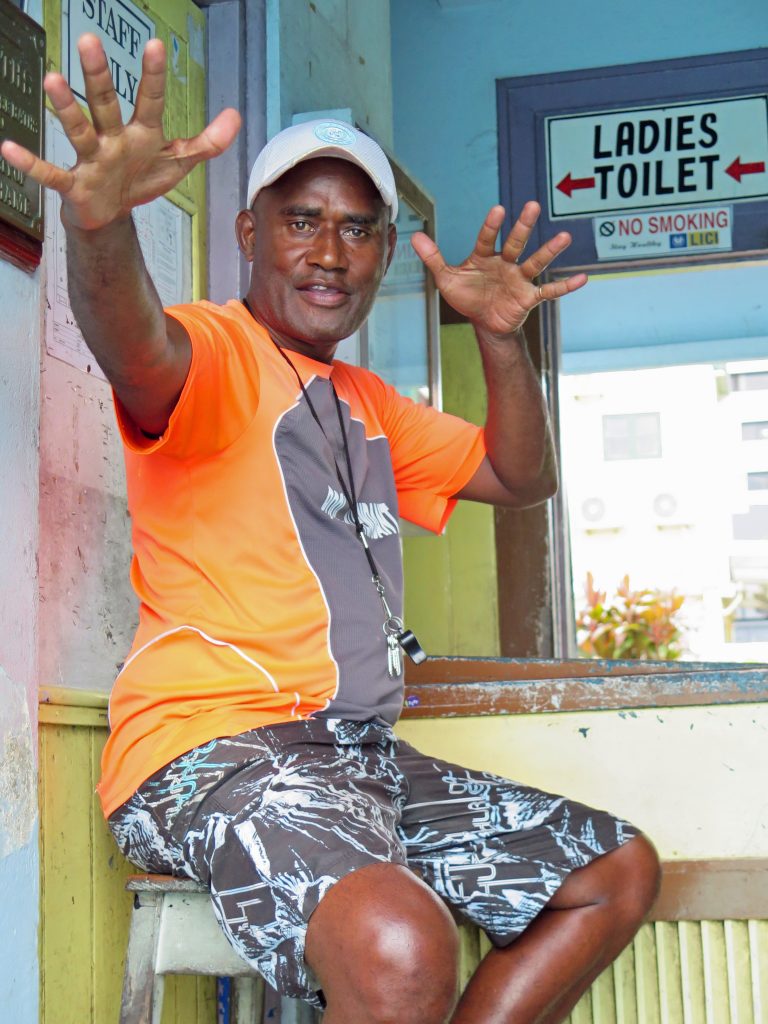
Behind the Old Town Hall is a very fine municipal Olympic-sized pool. It is open to the public, with an admission price of just F$3.
Always closed on Sundays, its operating hours from April through September are 10 a.m. to 6 p.m. on weekdays and 9 a.m. to 6 p.m. on Saturdays; and from October through March from 9 a.m. to 7 p.m. on weekdays and 7 a.m. to 7 p.m. on Saturdays. The facility also features a clean public toilet.
On any given day you’ll find a gaggle of school children splashing away or competing in meets organized by Fiji Swimming, the national governing body in Fiji for swimming competitions. Its online address is fijiswimming.org.
(Note that there is another Olympic-sized pool in Suva that is open to the public, at Laucala Bay behind the Damodar Plaza).
(9) St. Andrew’s Presbyterian Church
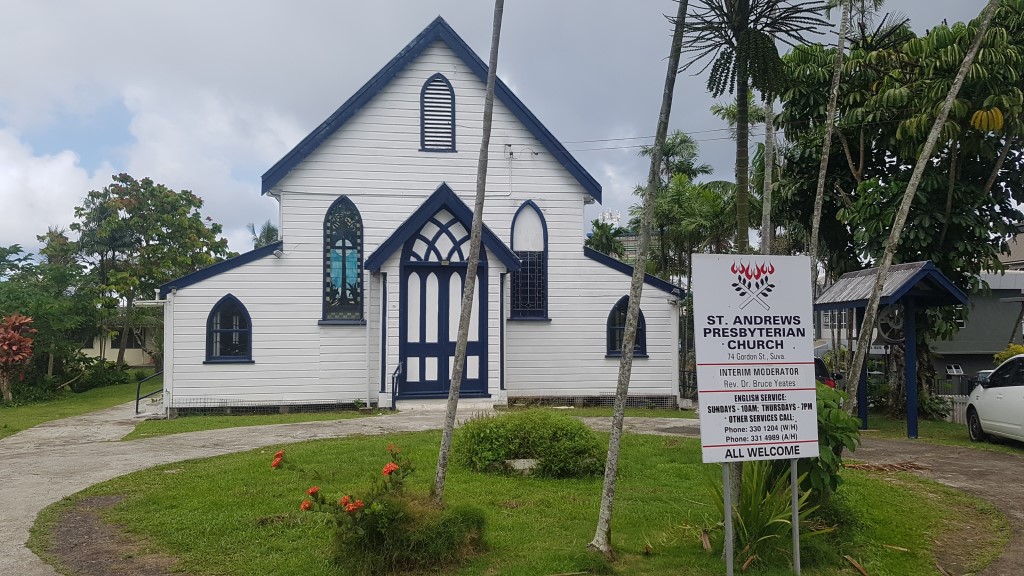
Surrounded by a white picket fence, this humble church is one of the oldest wooden buildings in Fiji.
On September 29, 1883 the Fiji Times (known then as the Suva Times) ran a story announcing the official opening of the church for public worship. Once associated primarily with the colonial settler families it slowly absorbed a wider community including students from the Pacific Theological College and the University of the South Pacific. Today it has a Facebook page and still offers regular services led by Rev. Dr. Bruce Yeates.
Architectural note: The St. Andrews Presbyterian Church is a folk Gothic Revival building with a front-facing gable form and two bays on either side. The symmetrical windows are pointed-arch shaped. The pair closest to the central entry is larger and more vertical, with original stain glass on one of the windows. The main entry is roofed with a gable-facing facade and wood-framed double doors.
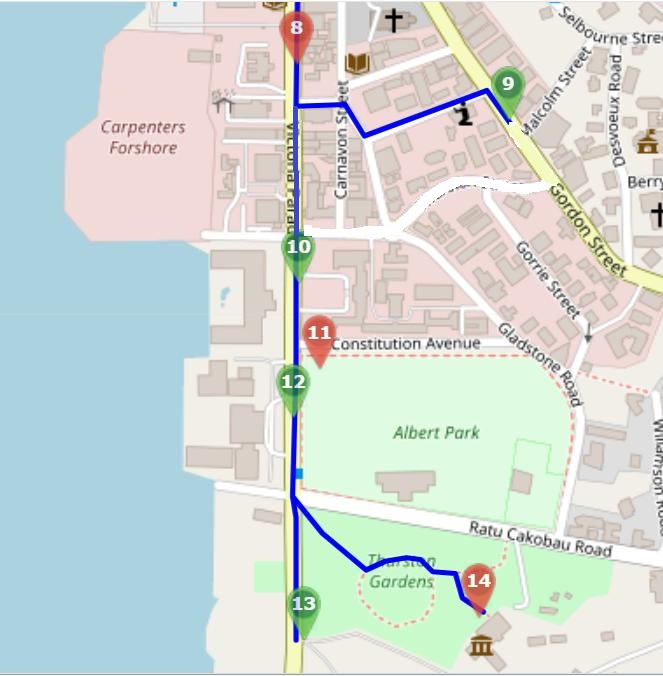
Retracing your steps back to Victoria Parade, continue heading south past the site of the former Golden Dragon nightclub (on your left above Golden Dragon Music), where many a Peace Corps Volunteer hoisted a glass. Pass the Mobil Station and look for the iTaukei Land Trust Board building on your left.
(10) Naiqaqi/Government Buildings Complex
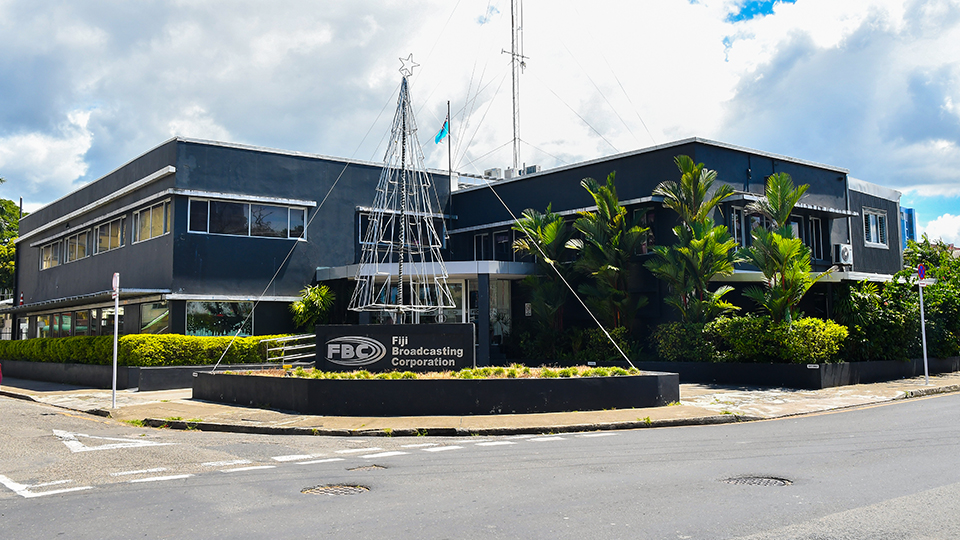
About 100 meters down from the library is an area called ‘Naiqaqi’, which translates as ‘the crusher’. This vicinity, which is now occupied by the iTaukei Land Trust Board (formerly the Native Land Trust Board) building, the Fiji Broadcasting Commission building and the site of the Government Buildings complex was once the site of Fiji’s first sugar mill, built in 1873.
Sugar grows quite well in Fiji but not in the Suva area, where the top soil is thin and ‘the crusher’ was never a successful business venture.
The only nearby remnant of this exercise in futility is a gear 1-1/2 meters in diameter, on display near the corner of Carnarvon and Loftus Sts.
Government Buildings
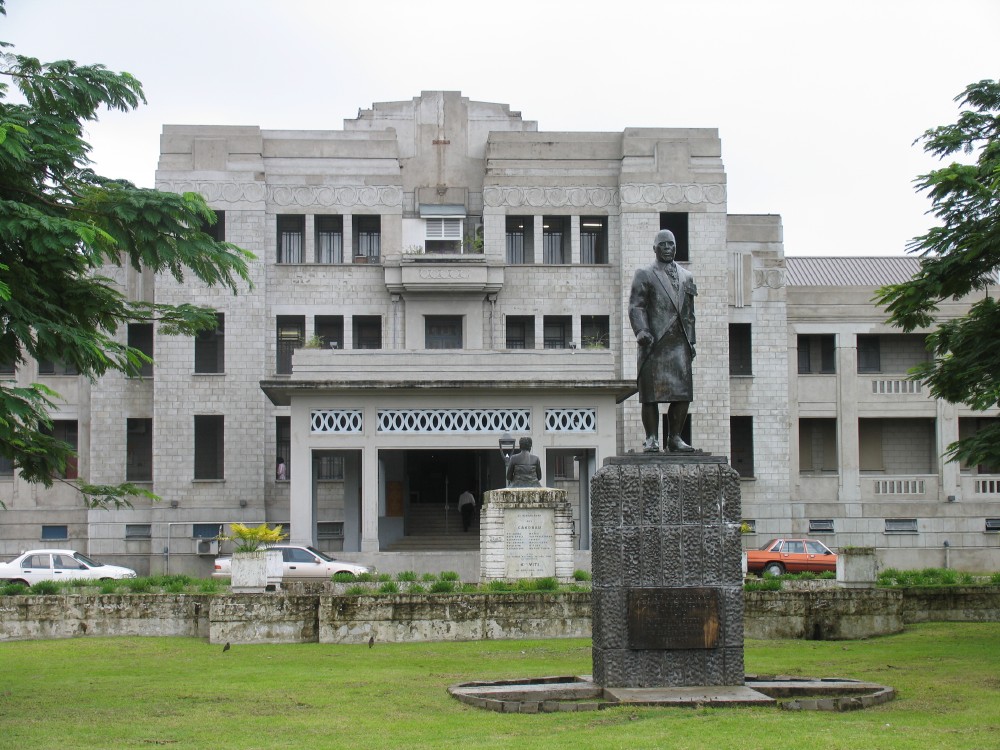
The massive Government Buildings site is one of the most prominent in Suva, but prior to 1935 the area was a swampy creek bed. Known as part of the greater Naiqaqi district, the area mostly contained tumbledown shacks and many of the neighborhood’s women plied the world’s oldest trade. The government buildings may be of more than passing interest to the visitor. Here the Department of Lands & Survey sells excellent topographic maps and city plans to the public. In the new wing, the Department of Information provides pamphlets such as Fiji Today, which offers an overview of the country, statistics and general background information. Nearby, in a barrack-like annex, is the office of the Fiji Dictionary Project. An impressive new parliament building, offering more space needed by the expanded post-coup government, was opened in 1992 on Ratu Sukuna Rd.
(11) Albert Park
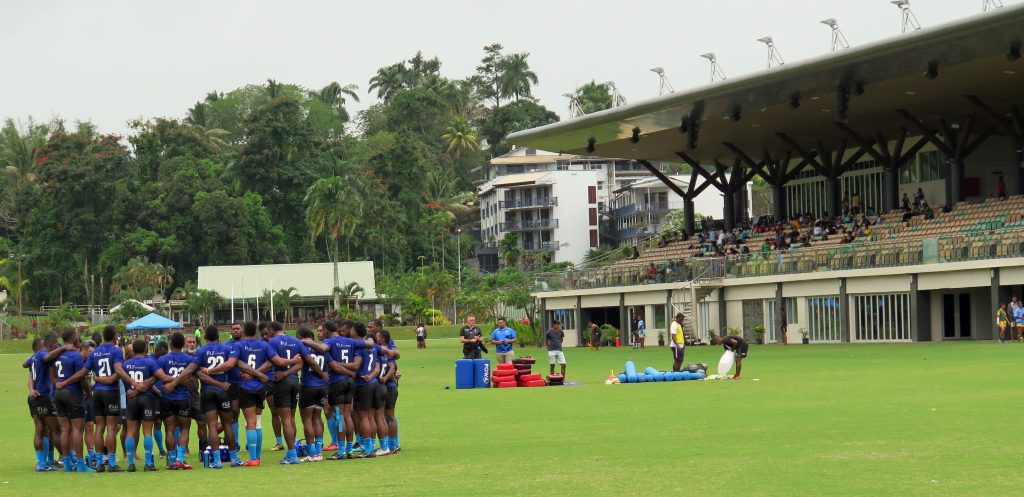
Albert Park, opposite the Government Buildings, was part of the original land grant given by the Polynesia Company to the government as an inducement to move the capital to Suva. Named after the royal consort to Queen Victoria, it is and always has been a general recreational park with a cricket ground and tennis courts. It’s gone through a recent upgrading which entailed raising the level of the pitch and adding some impressive new bleachers. (See photo at the top of this page).
Albert Park has been the site of several historical events, but undoubtedly the most famous was as the ad hoc landing strip for Charles Kingsford Smith, who made the first aerial crossing of the Pacific — from Oakland, California to Brisbane, Australia — in 1928.
Joined by Charles Ulm, copilot, James Warner as radio operator, and Harry Lyon as navigator, Smith took off from Kaua‘i, Hawai‘i, in his plane, the Southern Cross, without ever having seen his proposed Suva landing place. He did not know that a row of trees stretched across the middle of Albert Park, about where the pavilion now stands.
Only the insistent urging of the Suva radio station manager, Robert Farquhar, persuaded the governor — against the wishes of the town authorities — to order the trees cut down and the ground leveled with cartloads of coral rock and sand, to accommodate the incoming plane. On the other side of Victoria Parade, where the Holiday Inn now stands, telephone poles were lowered, and more trees removed to clear an approach to the park.
Aircraft approach techniques were unfamiliar to the layman in those days, and nobody thought it necessary to warn Smith that the level of the park was several feet below that of the road.
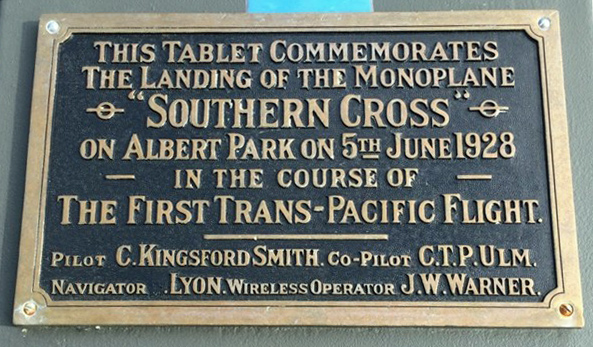
The Southern Cross had no brakes, but on the afternoon of June 5, 1928, with superb skill, Smith put the plane down in the park, with only feet to spare at the end as he swung the two-engine Fokker around almost at right angles and brought it to a stop.
With a light fuel load and heavy gear removed from the airplane, Smith and Ulm were able to take off from Nasilai Beach, about 20 miles away on the other side of the Rewa delta. There the Southern Cross was refueled, Warner and Lyon rejoined it, and it took off for Brisbane on June 8.
At the east end of the park are the tennis courts, which were filled and leveled with crushed soapstone cut from the site of the basketball courts near the museum and hauled through a tunnel under Cakobau Road.
To commemorate Constitution Day in 2016, Southern Cross Road, which bisects the Parliament and Albert Park, was renamed Constitution Avenue.
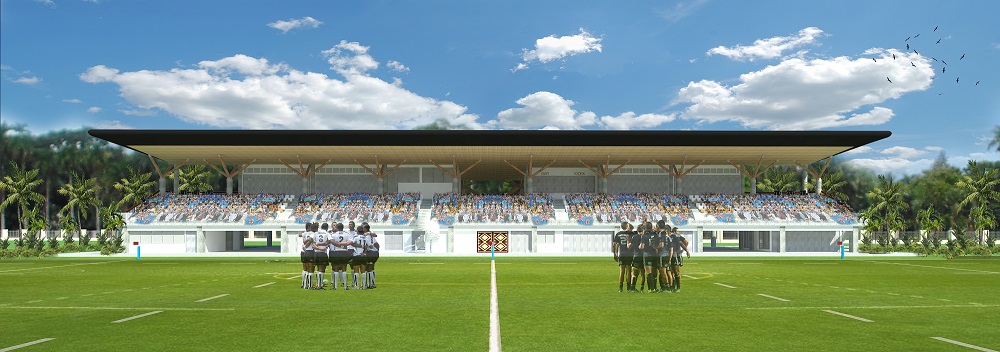
By 2019, upgrades to Albert Park had transformed the venerable grounds into a modern sports complex. The level of the pitch was raised with new soil, the problem of flooding was solved by installing a modern drainage system, and the area was refurbished with high-quality sod, which vastly improved the surface of the playing field. New fencing around the periphery was also installed.
The park’s crowning glory was the construction of a massive grandstand that can seat up to 1,000 spectators and includes corporate lounges, VIP rooms, seating for the disabled, a control room and parking for 28 vehicles.
(12) The Grand Pacific Hotel
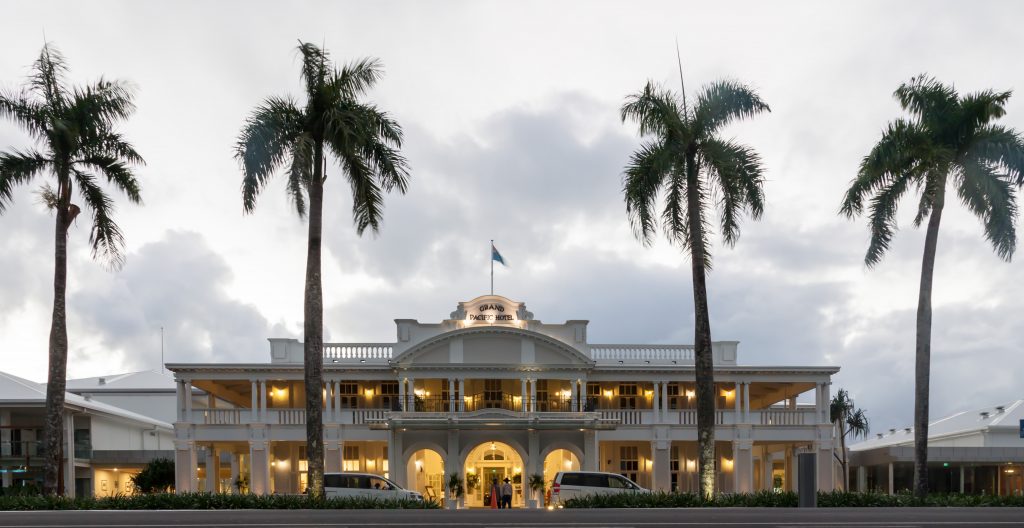
The site of the Grand Pacific Hotel was reclaimed from the “narrow fringe of sand, mud and seaweed” that Joske/Brewster saw when he arrived at Suva. That spot was once a landing place for commoners, known as Navunivesi, because of the clumps of vesi trees — Intsia bijuga (Colebr.) Kuntze, that grew there. The beach was called Navunimulomulo, named after another tree — Thespesia populnea (L.) Sol. ex Corrêa, Malvaceae.
In a little over 40 years, hotel accommodation in Fiji was changed from the rough shack that passed for the “Suva Hotel” to an edifice that set the standard for the entire Pacific. Built by the Union Steam Ship Co. as a staging point for New Zealand and Canadian-based shipping services in the North and South Pacific, the hotel opened in May 1914.
The design of the hotel followed that of the first-class accommodations in ships of the day. On one side, the bedrooms opened onto wide decks. On the other, they gave access to a balcony that looked down on the main lounge and dining room. Saltwater baths and shipboard plumbing were further reminders of the hotel’s architectural inspiration.
At its debut, it was proclaimed by The Fiji Times as “A Magnificent Structure,” as it was and is. Built of reinforced concrete, it was designed to catch the cooling trade winds:
All the rooms are well protected from the sun by 15-ft. wide verandahs and balconies, which surround the whole building, and electric fans are provided throughout. The tinting throughout is in art shades, cool tones only being used, with no dark shades, as these would be apt to provide harbouring places for mosquitoes.
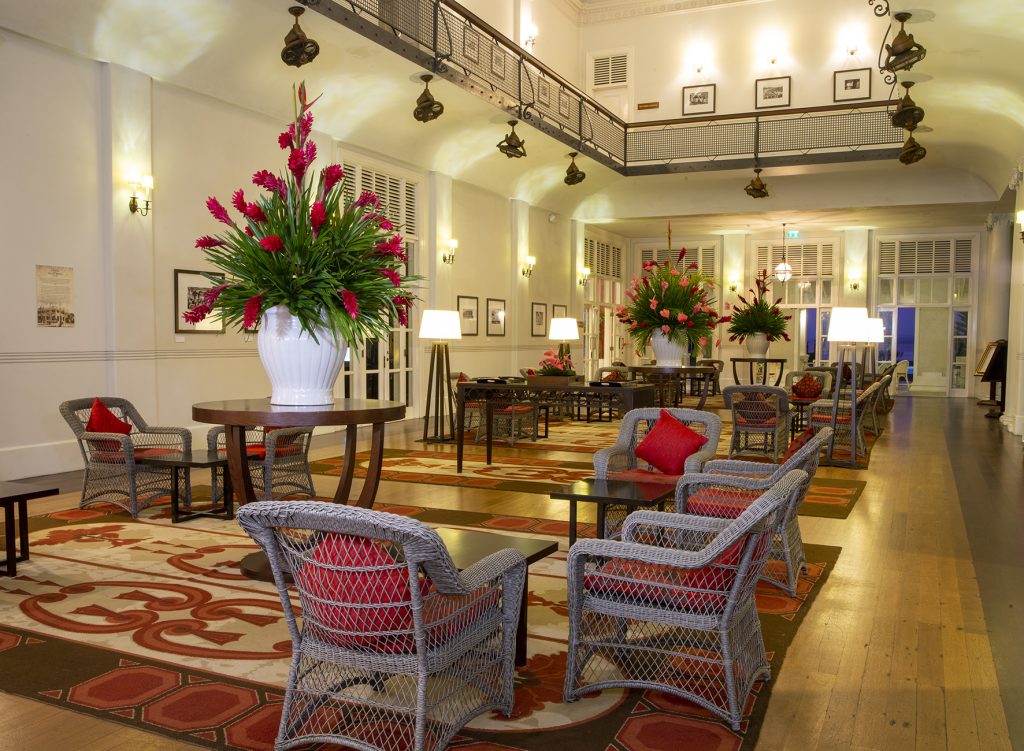
The front balcony overlooks the Parade, along which there is always passing a constant stream of natives, forming a fascinating procession, “infinite in variety,” which will be of never-failing interest to the tourist from a more temperate clime.
The public rooms, rather more numerous then than now, included a lounge, drawing room, billiard room, smoking room, bar and dining room. Nor were the guests overlooked in their private quarters. Said The Fiji Times:
The lavatory accommodation is most lavish and as sanitary as modern science can make it. … No less than 11 Twyford’s cast iron enameled baths are provided.
The epitome of service: storage tanks on the roof featuring movable lids so that bath water might be iced. The Herald Handbook reported in 1921:
A palatial building with broad verandahs and luxurious lounges, coffee rooms, etc., where cooling drinks or the refreshing cup of afternoon tea, are served in truly oriental style by white turbaned waiters.
Sadly, in the 1970s and ‘80s, the grand old lady inexorably declined. The past glory was etched indelibly on its façade, but during those years, it morphed into a sideshow, a dissolute Victorian-era caricature where rooms were often rented by the hour.
What to do? Everyone seemed to have an idea, and ownership changed, but nothing substantial happened. Finally, in 1992, it shut down.
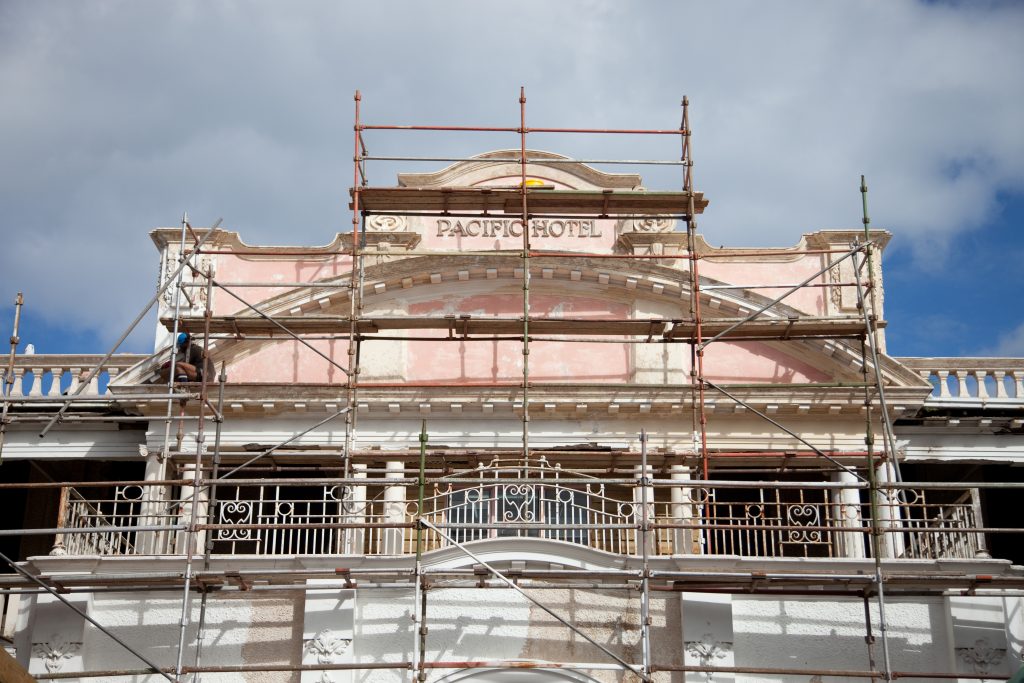
In 2011, plans for its reconstruction were announced. There would be a joint venture between the Fiji National Provident Fund, Papua New Guinea Superannuation Fund and Lamana Development PNG. The parties undertaking the project took pains to ensure accurate and — as the Grand Pacific Hotel website states, “sympathetic” — restoration of the building, with “input from many sources,” including the Fiji National Trust.
It’s not an exaggeration to say that those involved with the project did a magnificent job of restoration. Today the hotel is once more an icon. You can read about the newest incarnation of the Grand Pacific Hotel in the accommodations section.
On the next leg of the walking tour head down Queen Elizabeth Drive, past Thurston Gardens and you’ll come to the Government House Gate also known as the Presidential Palace.
(13) Presidential Palace Environs
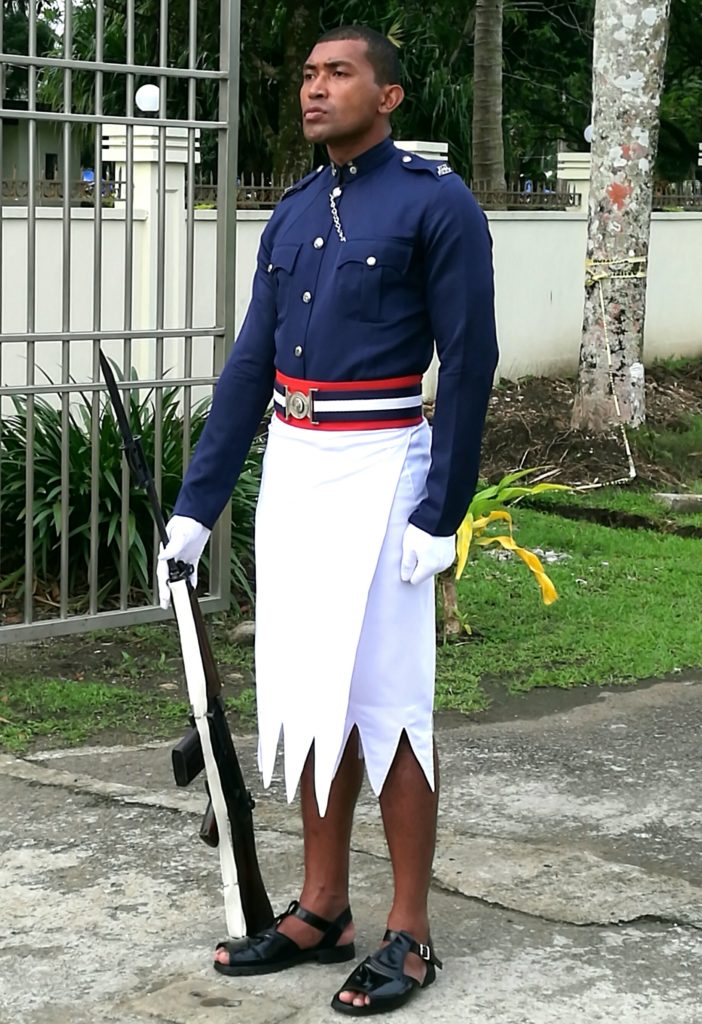
No, it’s not quite in the same league as Buckingham Palace, but the Presidential Palace (aka Government House) which was rebuilt in 1928 for the then British Governor, is still a Suva icon. Originally built in 1882, it was reconstructed following its destruction by lightning in 1921.
The residence of Fiji’s president is guarded by Fijian soldiers clad in starched white sulus (sarongs) and red tunics. There is one guard who stands at the palace entrance and once every month there is an exchange of on duty and off duty guards. Opposite the Presidential Palace is a path along the seawall, which makes a wonderful walk, especially in the cool of the early morning or the late afternoon. Essentially you’re walking along the roadside of Queen Elizabeth Drive, which begins in town and runs along the length of the peninsula which forms the contour of Suva.
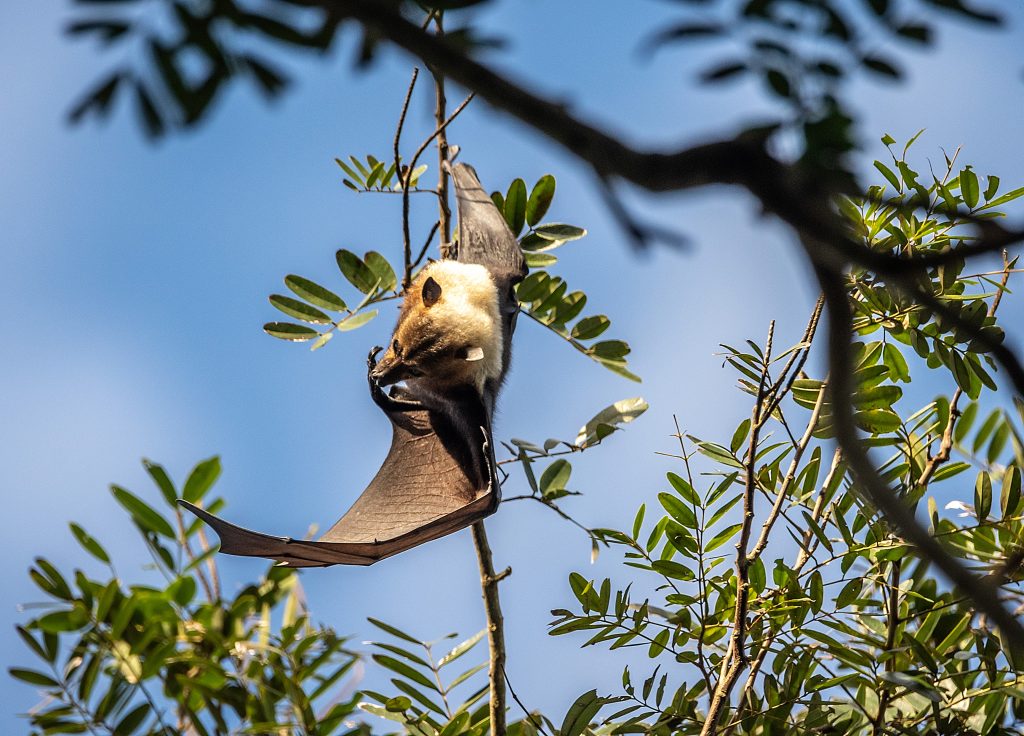
While you’re in the neighborhood, don’t forget the “Bat Trees”, which are on the premises of the Government House and are visible from the road. At dusk the magic begins as scores of fruit bats come to life in the tree. (Just park your care on seawalk side of the street, about 200 meters from where the sentry stands heading away from town).
You can clearly see the bats on several of the trees near the fence. Fruit bats, are rather large, noisy creatures and for those who have never seen them, are worth checking out.
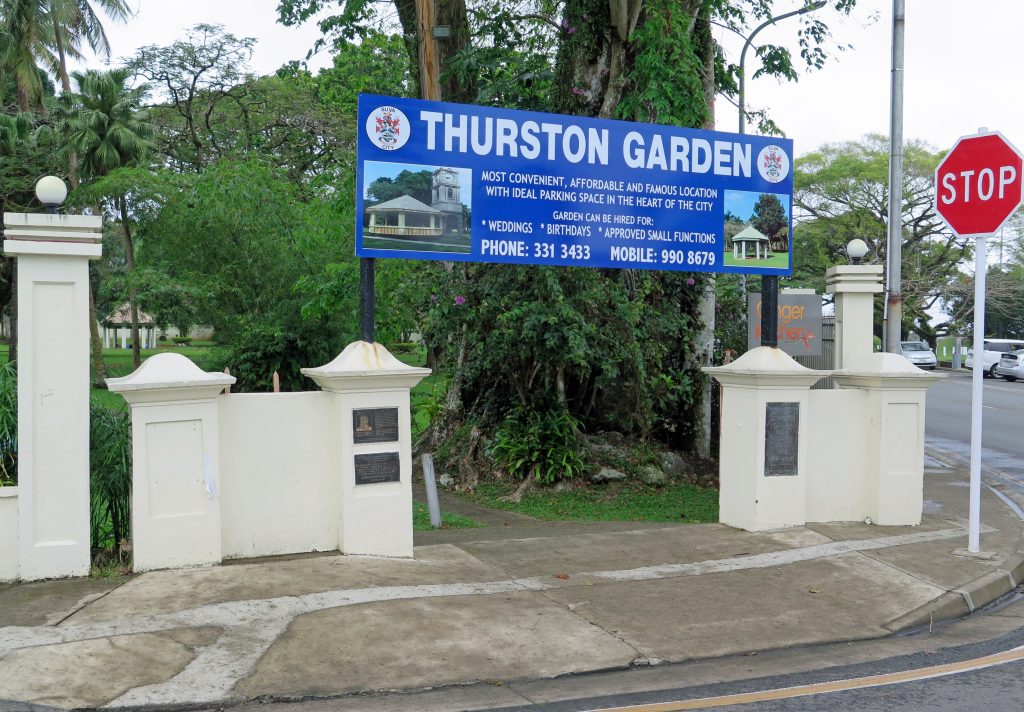
(14) Thurston Gardens/Museum complex
These gardens, long known as the Botanical Gardens, were renamed in 1976 in belated recognition of their founder, Sir John Bates Thurston, a knowledgeable amateur botanist.
One of the amenities of the gardens, the drinking fountain, was “Presented by Henry Marks for the use of the public visiting these gardens January 1914.”
Very shortly after that, a tragedy in the Marks family resulted in the presentation of the octagonal bandstand, with its classical, columned clock tower. Its plaque tells the story:
Erected by Henry Marks and Company Limited in memory of their late director G.J. Marks, first mayor of Suva who was drowned in the St. Lawrence River, Canada, through the sinking of the S.S. Empress of Ireland, 23rd May 1914.
The clock tower and bandstand were opened by the governor, Sir Bickham Sweet-Escott, on June 7, 1918, but even before then, the gardens were more often used for concerts than at present.
Somewhat off the path, nearer the center of the gardens, is a rectangular lily pond, with a fountain in the center. Three dolphins support a basin, on which stands a cupid-like character supporting another basin.
In 1949, the Thurston Gardens collection consisted of 20 types of ornamental and timber trees, and 17 types of palms and various trees, shrubs, grasses, orchids, and ferns.
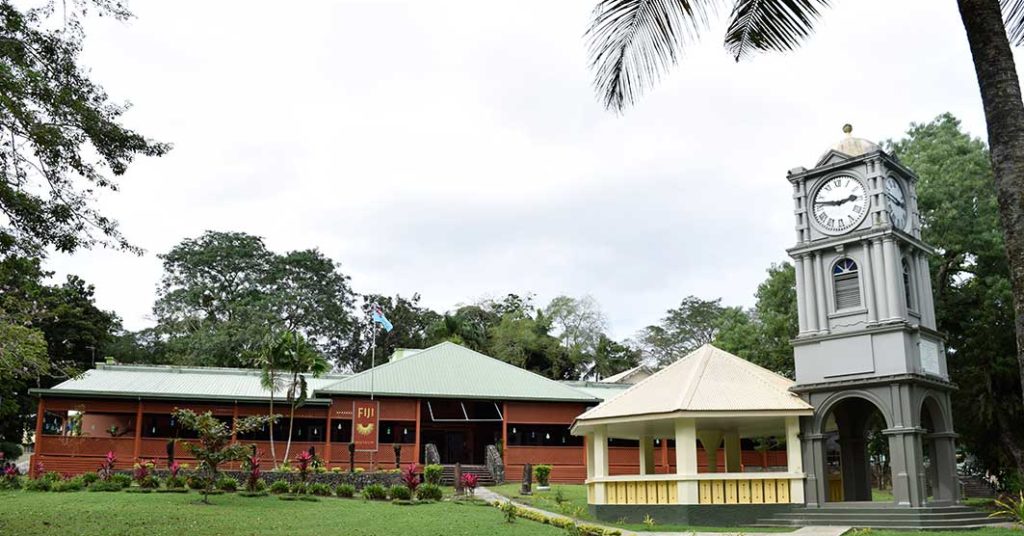
Fiji Museum
The Fiji Museum (inside Thurston Gardens) has the finest collection of Fijian relics in the world. Founded in 1904, the original site of the Fiji Museum was in the old town hall. After being moved to several locations, the present building was constructed on the grounds of Thurston Gardens in 1954. Despite the multitude of artifacts that were taken from Fiji by missionaries and sailors, the museum has the finest collection of Fijian relics in the world.
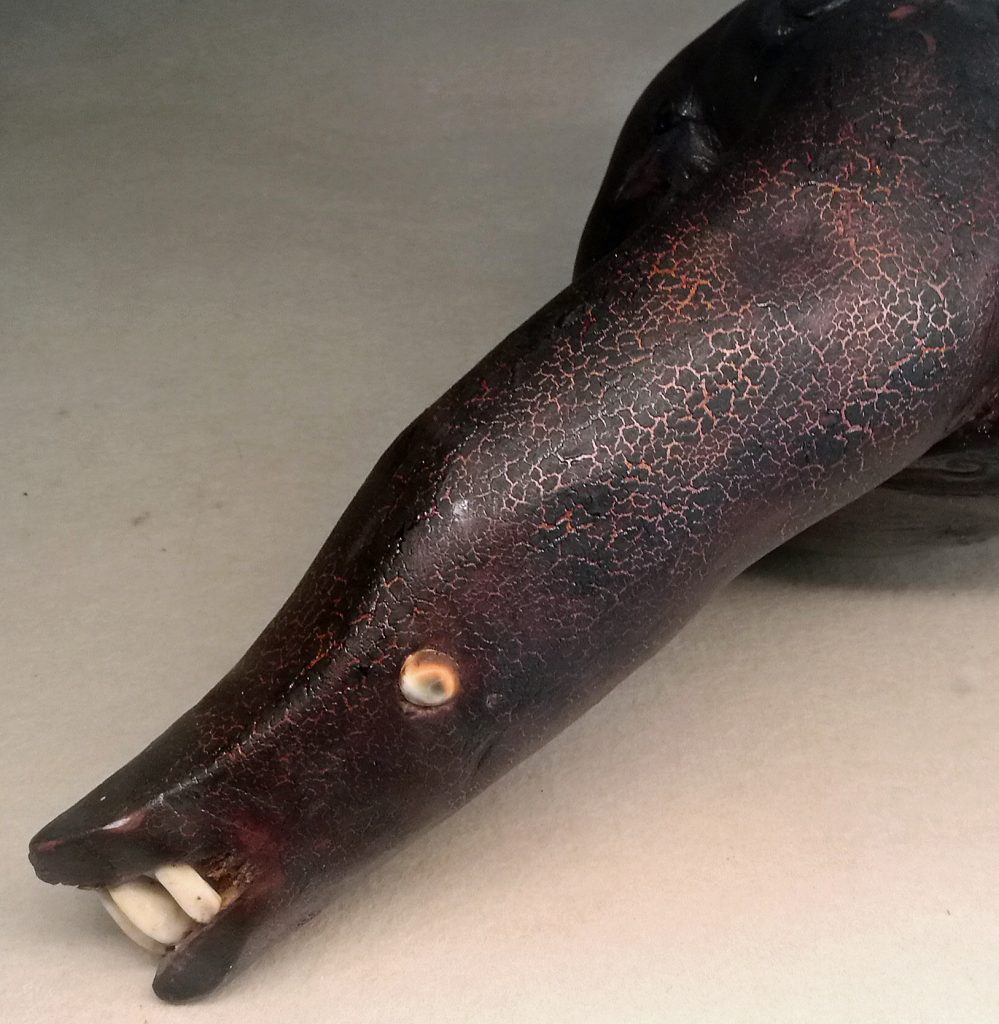
Among the exhibits are collections of war clubs, ivory necklaces, cannibal forks, spears, bowls, pottery, tools, cooking utensils, combs and a replica of a huge drua – an ancient, double-hulled canoe. One of the war clubs, which was actually used in battle, has several notches chiseled in it, each representing an enemy slain.
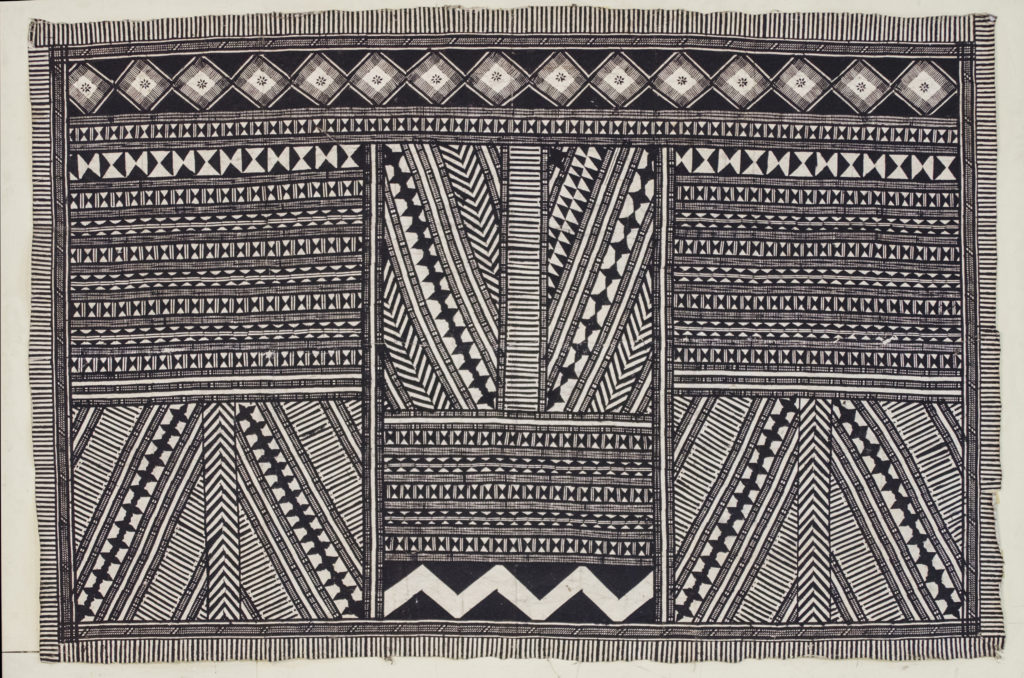
The rear of the museum is dedicated to the arrival of European and US sailing vessels, highlighting the Bêche-de-mer , whaling and sandalwood eras. There is also an exhibit illustrating the saga of the Indian indenture period and the infamous blackbirding trade that brought Micronesians and Melanesians to Fiji. In addition, you’ll see actual relics from the famous Bounty. There is a superb collection of old masi (tapa bark cloth) in an air-con room.
Aside from collecting and chronicling Fijian artifacts, the museum is also a research and educational institution. The staff engage in archaeological research, the preservation of Fiji’s oral tradition and publication of material on language and culture.
In addition to its “brick and mortar” location in Thurston Gardens, the Museum has a virtual museum component available online.
Opening Hours
The museum is open weekdays from 8.30 am to 4.30 pm, Saturday from 9 am to 4.30 pm and is closed Sunday. There is an admission charge. There is often a temporary exhibit of some kind going on, and these are usually excellent. Anyone visiting Suva should not miss the museum.
Nightlife & Performing Arts Scene
Suva is famous throughout the South Pacific for its nightlife. Clubs range from seedy dives to posh discos. Clubbing is a popular recreation for urban, single Fijians and is socially quite acceptable – many charitable and social organizations use the clubs as places to hold fund-raising dances.
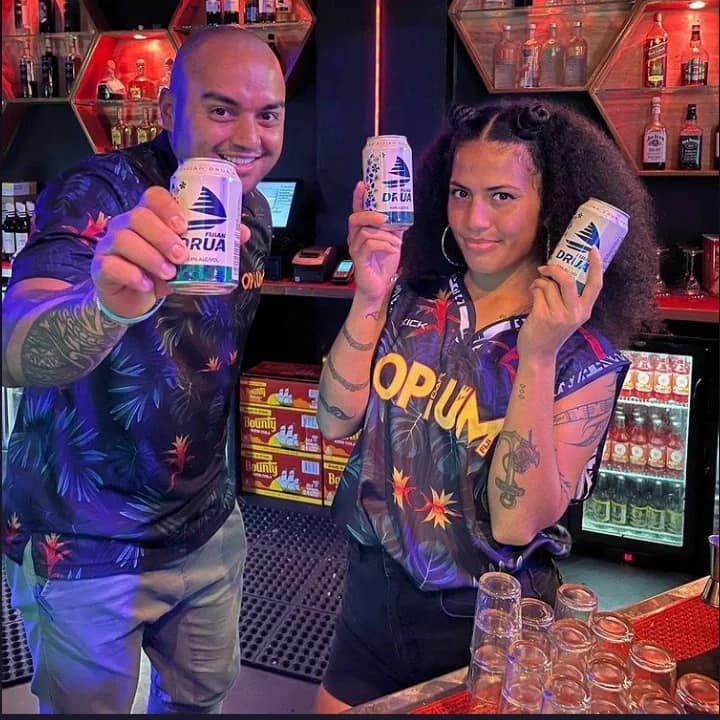
Traps, Onyx, Wrecktangles Night Club, O’Reilly’s and Top Dog Cafe, Opium Bar Fiji–all in the downtown Suva area–are some of the most popular nightclubs in town. The Lawn Bowling Club near the GPH is not a nightclub but they occasionally have entertainment and yes, they are lawn bowling club.
All of the night spots cater to locals rather than the tourists. The good news for visitors is that locals are often very interested in meeting vulagi (visitors) so there is no shortage of singles seeking companions.
Performing and Fine Arts in Suva
Suva has long had an arts scene that entails, among other things, music, theater, poetry, dance fashion, and fine arts. The art scene continues to evolve. There’s even an online art magazine called ARTtalk which covers everything from photography to dance theater in Fiji.
If you’re visiting town there are several venues to check out:
Center for the Arts (CAS) is a newly inaugurated gallery space for emerging local artists. It’s the first dedicated public art gallery in Suva and is an important step in the evolution of the local art scene. Located in Walu Bay (where?) and funded by a US Embassy Economic Recovery Grant, its mission is to be a center accessible to the Fijian public, art teachers, traditional artisans, international and virtual tourists as well as the greater Pacific diaspora. According to the co-founder, Peter Sipeli, CAS aims to collaborate with arts organizations, donors, embassies and other institutions to ensure greater access and exposure for artists and their work.

Oceania Centre for Arts and Culture is affiliated with and based at the University of the South Pacific located on Laucala Bay Road in Suva. In their own words, they are a “space specialising in Oceanic Dance, Music and Visual arts. The arts center is associated with a Pacific Studies Programme which “explores Oceanic arts, indigenous knowledge and cultural sustainability”. The Oceania Centre presents plays, dance events and exhibitions on campus. Stay apprised of their events by visiting https://www.facebook.com/OceaniaCentreUSP/
Moana Loa Performing Arts Center is located in the Suva suburb of Lami that combines fine and performing arts with fitness classes all under one roof. They call themselves a “One-stop Center for the Arts” which houses Fiji’s only Aerial Arts School. Other activities include a children’s choir, and classes in “acro gym”, pilates, dance (including hip hop), acting, vocal training and painting and Fitness classes. The Center includes a performance venue. See https://www.facebook.com/moanaloapac/
The Fiji Museum occasionally hosts performances such as poetry readings or art exhibitions on their wonderful, spacious deck which overlooks Thurston Gardens. See https://www.facebook.com/fijimuseum/ for upcoming events.
The Festivals Company promotes everything from nightclub disco parties and hip hop competitions. Founded by local entrepreneur, Sharleen Ali, the Festivals Company Facebook page offers a great place to apprise yourself of concerts and just about every other pop culture happening: https://www.facebook.com/thefestivalscompany.fiji
Another place look for local bands, events and music festivals in Suva and around Fiji is Knox Entertainment: https://www.facebook.com/knoxmusicfiji
Beaches and attractions outside of Suva
Pacific Harbour

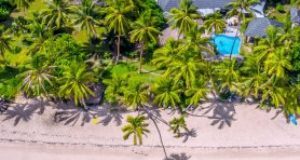
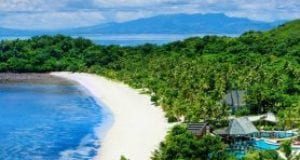
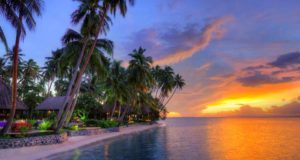
There is a beach in town but it may not be up to the standards of international travelers. Your best bet for a nice day at the shore is to head down to Pacific Harbour (see photo above), which is about 20 minutes by car out of town.
Colo-i-Suva Forest Park
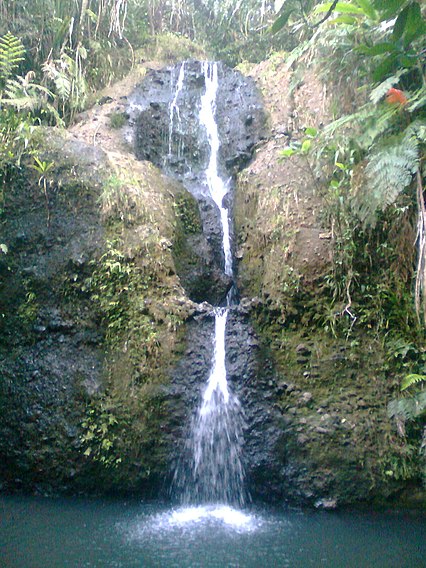
A ten to fifteen minute drive from Suva down Princes road, Colo-i-Suva is a national park where you’ll find a river forming countless crystalline pools perfect for a dip on warm day. Surrounded by a rainforest canopy, it’s a perfect get away from the frenetic pace of Suva.
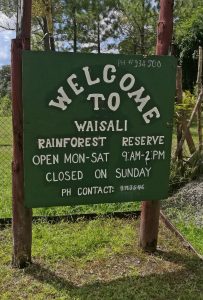
Established in 1872, the park consists of two and a half square kilometers of verdant forest. The Waisila Creek flows through the Colo-i-Suva Forest National Park in Fiji making its way to Waimanu River.
African mahogany, planted in the 1940s and 1950s, stands apart from the older native vegetation.
There are 6.5 km of hiking trails and it’s ideal place to go bird watching. There are two waterfalls in the park. Waisila Falls is the most well known. It’s approximately fifteen meters deep making it a perfect swimming hole.
Nausori
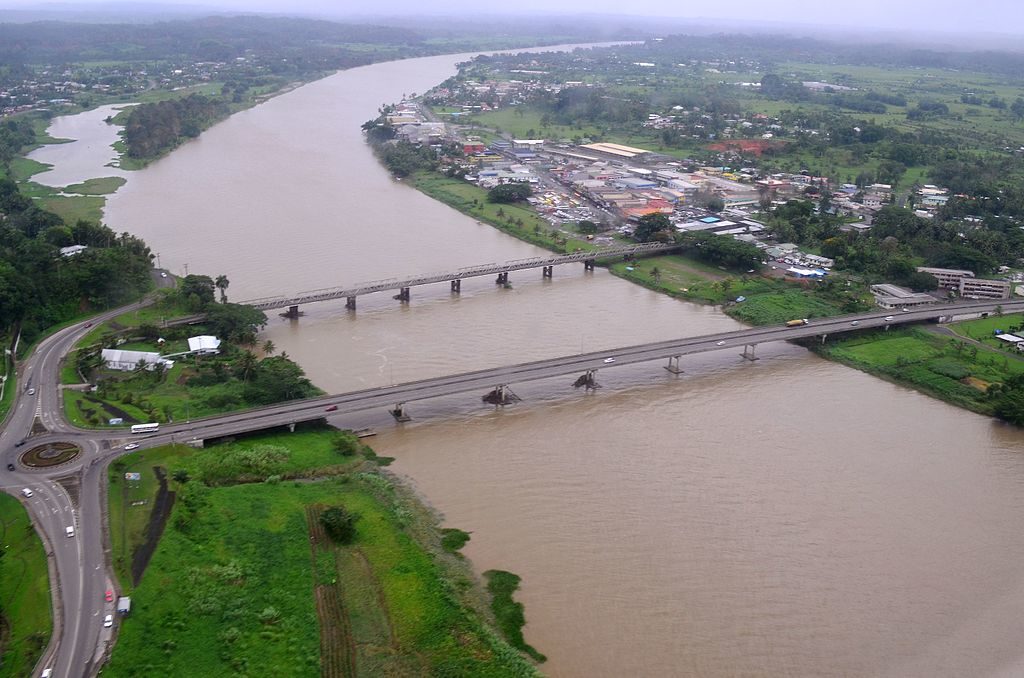
Only 19 km north of Suva and 270 km from Nadi Airport, Nausori grew as a city around Fiji’s second sugar mill (1881-1959), now the site of the Rewa Rice Mill. The golf course and some of the old colonial homes constructed for expatriates are about all that remain of Nausori’s days as a sugar-mill town. (The post card below from Dame Jane Resture’s collection depicts pay in Nausori in 1906.)
The end of the sugar mill marked the final attempt at growing sugar on the eastern side of Viti Levu. Today Nausori is much like Ba, a working-class town and agricultural center. The airport, which serves Suva is in Nausori, a 20-minute drive from the capital.
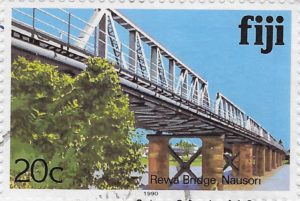
The most famous landmark in town is the old Nausori Bridge, which everyone who lands at the Airport had to cross to get to Suva. The bridge was immortalized in this 1979 postage stamp). It’s been superseded by newer, safer bridge. (The old one is no longer in use).
Near Nausori are three landings from which you can hire punts or ‘water taxis’ to explore the Rewa Delta, visit snorkeling areas or visit Toberua Resort. The landings are Nakelo, Wainibokasi and Bau. Buses leave frequently for these points from the bus station in Nausori.
Bau Island
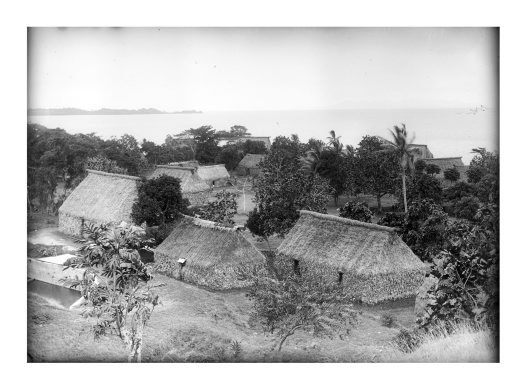
Bau Landing is a few meters from tiny Bau Island, to this day the seat of traditional power among Fijians (see the History section). The island is not a place where visitors may casually drop in – it is in fact against the law to visit Bau without permission from someone who lives on the island or from the Ministry of Fijian Affairs. This applies to locals and visitors alike.
Bau has the oldest church in the country, a fascinating cemetery for chiefly families, and an impressive stone n earby that was once used to crush skulls in the days of cannibalism.
If you really want to visit the island, the best way to go about this is to try and befriend someone on the bus ride to Bau Landing; in hopes that the person may offer to show you around.
Make sure you take a large bundle of kava root (waka) with you and dress conservatively (applies especially to women). At certain times all non-Bauans are forbidden on the island, so don’t attempt to reach it without permission; and if by luck you get there, never walk around un-escorted. Some tourists reportedly have tried this but it is a grave insult. Getting on the wrong side of a Fijian chief is akin to getting on the wrong side of the law. In many remote parts of Fiji the chief is still the one who lays down the law. Even the courts have ruled that a chief’s word can in some cases take precedence over the law books.
Naililili Mission
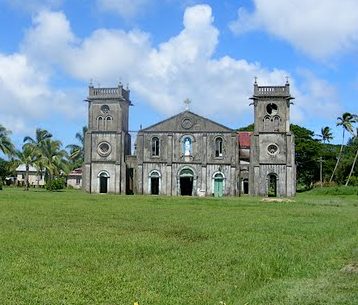
Naililili, 272 km from Nadi Airport, is the largest church in Fiji. Naililili Church was built at the turn of the century by Father Rougier, who later left the priesthood to become a trader in Tahiti. Apparently Father Rougier accidentally inherited a tidy sum from a down-and-out convict from New Caledonia who was in reality heir to a fortune. At that point he left organized religion to seek a more worldly life. To get to his church take the first left at the junction past the Nausori Bridge. Water taxis are available to cross the river to Naililili.
Very well explained in the past and the now or the today’s update for Suva and Nausori sight seeing. Thankss for the details especially for the children now days to know the history of Suva and others that Fiji is known for.